
The Power of the Subconscious Mind
Understanding the Hidden Driver of Human Behavior
While we often believe we are making conscious, logical choices every day, science tells a different story. In reality, as much as 95% of our daily behavior, thoughts, and decisions are influenced by the subconscious mind (Lipton, 2005). This vast inner reservoir of memories, beliefs, and emotional patterns operates quietly in the background—and yet it steers the course of our lives more than we realize.
In this article, we will explore the subconscious mind as a general concept: what it is, how it functions, where its programming comes from, and why understanding it is key to making meaningful change. No specific modalities are discussed here—this is for anyone who wants a foundational understanding of one of the most powerful forces within us.
What Is the Subconscious Mind? The subconscious mind is the part of the brain that lies just below our conscious awareness. While your conscious mind is the part you actively use to think, plan, and make decisions, the subconscious is constantly running the deeper programming that informs those choices. It stores:
Core beliefs and identity narratives
Emotional and sensory memories (especially unresolved ones)
Repeated thought patterns and habits
Perceptions and learned behaviors
According to cognitive neuroscientists, only about 5% of our cognitive activities (decisions, emotions, actions, behavior) are conscious, while the remaining 95% is generated by non-conscious processing (Bargh & Morsella, 2008).
When and How Is the Subconscious Programmed? Most of your subconscious programming is laid down early in life:
From the third trimester of pregnancy through age seven, a child’s brain predominantly functions in theta and delta brainwave states—the same states accessed during hypnosis and deep meditation.
These early years are when children are most impressionable. They absorb beliefs, language, cultural norms, fears, and expectations directly from their environment—without critical thinking or analysis (Siegel, 2012).
Emotional experiences during this time are deeply encoded and often reappear later as automatic emotional reactions or behaviors.
Even before birth, a fetus can respond to its mother's emotional state, hormonal signals, and sound environment, influencing early conditioning (Verny, 1981).
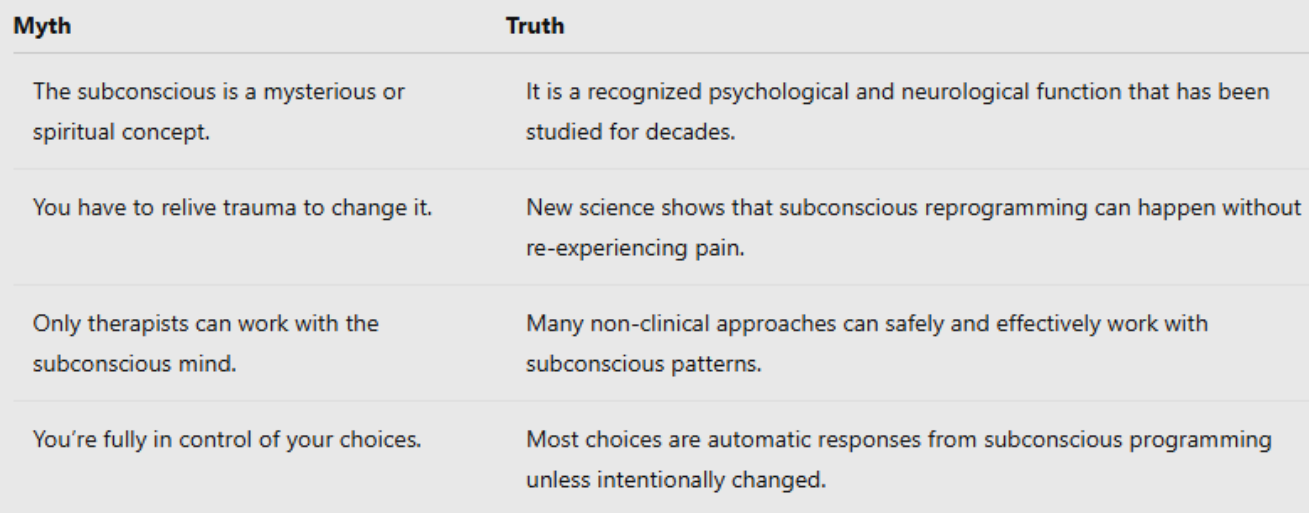
Common Myths vs. Truths About the Subconscious Mind
Scientific Data Supporting the Power of the Subconscious
Dr. Bruce Lipton (2005) states that up to 95% of our behaviors and reactions are controlled by subconscious programs developed by age 7.
The work of Dr. Daniel Siegel (2012) emphasizes how early interpersonal experiences shape neural circuitry that becomes our emotional and relational baseline.
Dr. Bessel van der Kolk (2014) showed how traumatic experiences are stored not just as thoughts, but as imprints in the body and brain, influencing our responses unconsciously.
Dr. John Bargh (Yale University) demonstrated that much of our social behavior is triggered unconsciously, influenced by stored associations.
What Information Lives in the Subconscious? The subconscious stores everything that has ever entered your awareness—even if you don’t remember it consciously. This includes:
Emotional memories (especially charged events)
Parental and cultural belief systems
Language, accent, voice tone conditioning
Survival patterns (fight/flight/freeze)
Self-worth narratives
Triggers and trauma imprints
Why Understanding the Subconscious Is So Empowering For decades, people believed the subconscious was static and unchangeable. But thanks to the rise of neuroplasticity, we now know that the brain can be rewired. Thought patterns can be changed. Emotional triggers can be softened or erased. Even deep-rooted beliefs can be replaced with empowering ones.
The key is that these shifts must happen with intention and awareness. Before beginning any process of transformation, it is important to reflect:
What beliefs are holding me back?
Why do I want to change?
What do I consciously choose to believe now?
This reflection gives us the chance to design our future—not based on who we were or what happened in the past, but on who we are becoming.
You Can Rewire Your Life The subconscious mind is not a vault that traps your past—it is a malleable system that can evolve with you. Science has shown that with the right tools and awareness, we can safely and respectfully access and rewire the programming that no longer serves us.
Before you begin any process of reprogramming or change, take time to get clear: What do you truly want to believe about yourself and the world? Once that’s defined, you can begin the process of consciously installing those beliefs. The life you once thought was impossible is often just a few subconscious shifts away.
References
Lipton, B. H. (2005). The Biology of Belief. Hay House.
Siegel, D. J. (2012). The Developing Mind. Guilford Press.
van der Kolk, B. (2014). The Body Keeps the Score. Viking.
Bargh, J. A., & Morsella, E. (2008). The unconscious mind. Perspectives on Psychological Science, 3(1), 73–79.
